The Bird That Knew About Rent
Kamau's balcony birds start repeating the estate's secrets.

The first bird arrived in a Blue Band carton with holes punched into the lid by a nail.
That was five years ago, when Old Karanja was still the night watchman at Sunrise Court, before his chest started making that small radio sound and before his sons came from Murang'a and collected his mattress, his thermos, and his silence. He found the bird behind the transformer house at 3am, one wing hanging like a broken umbrella. He knocked on Kamau's door because, in an estate, jobless men are assumed to be available for all emergencies that do not require money.
"Weka tu mpaka asubuhi," he said. Keep it until morning.
Morning came. The bird remained. Then another one came, rescued by children from a cat near the garbage bay. Then a third, bought from a boy at the stage who claimed, with the confidence of Nairobi boys, that it was "a very rare species, boss, from Mombasa side."
It was not from Mombasa side. It looked like it had been assembled in a hurry by someone using spare feathers.
By the time the fictional Department of Small Nuisances and Public Calm entered Kamau's life, he had seven birds on his balcony and a name he had not applied for.
Birdman.
In Nairobi, a nickname can be a curse or a business plan. His was both. Kamau had no job. He had a diploma in procurement, three CVs saved in different cyber cafés, and one black trouser that knew every interview room between Upper Hill and Industrial Area. But in Sunrise Court, he had status. Children pointed at his balcony the way tourists point at giraffes. Women coming from the kiosk slowed down to hear what the birds would say. Men lowered their voices when passing under his clothesline.
The birds did not sing. Let us not romanticize them. They shouted.
They shouted like women calling children from the fifth floor. They shouted like conductors at rush hour. They shouted like pastors when the keyboardist has found the right chord. And sometimes, because birds are small feathery thieves, they stole the estate's sentences and returned them at the worst possible time.
"Kwani rent ni ya serikali?" one of them screamed one Saturday morning, in the exact voice of Omondi the caretaker.
The whole courtyard froze.
Omondi, who was standing near the water tanks with his whistle around his neck, looked up at Kamau's balcony with the hatred of a man who had been quoted accurately.
Another bird, a green fellow with one cloudy eye, had mastered Mama Atieno's sigh. Not the normal sigh. The one she used when her husband came home smelling of beer and courage.
"Eeeh, Bernard," the bird would say, drawing the name until it became a court case.
After that, Bernard stopped sitting in the corridor after 10pm.
You see why people loved them. The birds were not pets. They were minutes of meetings. They were CCTV with feathers. They knew whose gas cylinder had been borrowed permanently. They knew which tenant said she was going to church kesha and returned at noon with sunglasses. They knew who was not in Dubai, despite posting Dubai quotes, because one bird had heard him bargaining for smokies at the stage.
Kamau's sister Wambui did not find any of this funny.
Wambui worked in accounts for a company that sold imported tiles to people building houses they would visit twice a year. She wore blazers even on Sundays. When she sat, she crossed her legs as if there was a board meeting under the table. Once a month she came to check whether Kamau had become a man.
She would stand at his door, handbag clutched at her elbow, and look past him at the balcony.
"Are they still here?"
"As you can hear."
From the balcony: "Eeeh, Bernard."
Wambui closed her eyes. "This is exactly what I mean."
"What?"
"You are becoming a story people tell when they want to feel better about their sons."
That sentence stayed with Kamau because it was cruel in the way only family can be cruel; it knew where the spare key was hidden. His mother said the same thing more softly. She said, "My son, even a strange thing needs a plan."
But the birds had become his plan. In the morning he cleaned their cages with an old toothbrush. He cut sukuma stems into small pieces. He changed water in the margarine tins. He spoke to them before speaking to any human being. When they flapped, feathers rose and stuck to his wet hands. Their noise filled the spaces where his phone did not ring.
The blue cage remained in the corner, dented and peeling, the first one Old Karanja had given him. Kamau never put the loud birds there. It belonged to beginnings. Sometimes, in the evening, he would touch its wire door and remember the old man telling him, "Birds only keep quiet when they don't trust the room."
On Tuesday, the room stopped trusting him.
A man arrived wearing a brown suit the colour of weak tea. He had a clipboard, a lanyard, and the exhausted politeness of someone paid to end other people's nonsense. Omondi escorted him with too much happiness.
"This is the residence," Omondi said, as if he had discovered a crime scene.
The man cleared his throat. "Mr Kamau?"
"That is me."
He handed Kamau a letter. It had a stamp large enough to make any Kenyan humble.
"Due to repeated complaints concerning noise, hygiene, and unauthorized keeping of birds within a residential compound, you are hereby instructed to surrender the said birds within twenty-four hours."
He said "said birds" like he had been waiting all morning to use it.
From the balcony, the green bird shouted, "Kwani rent ni ya serikali?"
Omondi coughed.
Kamau read the letter twice, not because it was long, but because the first reading had removed all the air from his chest.
"Who complained?" he asked.
The man looked at his clipboard. "Residents."
"Residents have names."
"Complaints are confidential."
Confidential. In an estate where even your cough is discussed by 10am.
By evening, Sunrise Court had formed committees. Nairobi people can organize very quickly when there is no money involved. The aunties gathered under Kamau's balcony with lessos tied tightly and faces full of national concern.
"You cannot allow this," Mama Njeri said. "Those birds are community assets."
"Assets?" Kamau asked.
"Yes. They help us know things."
"What things?"
She looked at him as if he was wasting oxygen. "Important things."
Behind her, Mama Atieno said, "Some of us have been warned by those birds before shame arrived."
Bernard, passing with bread, suddenly remembered another route.
But not everyone wanted them to stay. Omondi stood near the staircase pretending to check bulbs. The birds had once shouted, "Token imeisha!" each time lights flickered in Block B, and after that people started asking why the common-area meter behaved like a drunk uncle. The salon lady said the feathers entered her towels. The young mother in 2C said her baby had learned to scream like them. A man who worked night shifts said he dreamt in bird voices.
So there it was. Kamau's small balcony had become Parliament.
That night his mother came with Wambui. His mother carried bananas in a paper bag, because mothers cannot come to disaster empty-handed. Wambui carried nothing except solutions.
They sat in his room on the sofa with plastic covers that sighed whenever anyone moved. The birds rustled outside. The whole estate seemed to be listening through the walls.
Wambui placed the letter on the table and smoothed it with her palm.
"This is a blessing," she said.
"A blessing with a stamp?" Kamau asked.
"A chance. You surrender them, clean this place, then come stay with me for two weeks. We update your CV. I know someone in HR."
"I don't want to stay in Kileleshwa like a rescued cousin."
"You prefer being a zoo?"
Their mother flinched. Wambui saw it and softened, but only a little.
"We are not against you," she said. "We are tired of defending you in rooms where you are not present."
The birds went quiet then, as if even they knew not to interrupt family shame.
Kamau wanted to tell her the birds had defended him in rooms where he was too present. In the morning when men with jobs passed in ironed shirts and nodded at him with pity. In the afternoon when he sat with his phone, refreshing emails that did not refresh back. At night when the estate lights went off one by one and loneliness came to stand in his doorway like a landlord.
Instead he said, "They are not just noise."
Wambui looked at the balcony. "Then what are they?"
Kamau did not have an answer that would survive her accounting mind.
At midnight, after his mother and sister left, he sat outside among the cages. It had rained lightly, the mean Nairobi rain that wets railings and leaves dust untouched. The birds shifted in their sleep. One opened an eye.
Below, Sunrise Court had become the kind of quiet that comes after people have said too much. A basin dripped somewhere. A boda coughed at the gate. Omondi's whistle hung dark against his shirt as he made his last round.
Kamau touched the blue cage.
Old Karanja had died with very few things, but he had left this dented thing and the sentence about trust. For years Kamau had told himself he was saving the birds. Maybe he was also asking them to save him loudly, so nobody would notice he had become quiet.
In the morning the brown-suit man returned with a van. He had brought two younger men with gloves and the bored faces of people who move other people's problems for a living.
The estate gathered without being called.
Mama Njeri stood with her arms folded. Mama Atieno had tied her scarf like she was attending a funeral. Bernard remained upstairs but his curtain had a human-shaped gap. Wambui came too, in a grey blazer, standing beside their mother near the staircase. Omondi hovered at the gate, trying to look official.
The man with the clipboard asked, "Are we proceeding voluntarily?"
Kenyans love that word, voluntarily. It means: do it before we make you do it.
Kamau nodded.
One by one, the cages were carried down. The birds woke into panic. Wings beat against wire. Feathers came loose and drifted around them. The green one shouted, "Eeeh, Bernard!" and the courtyard, traitor that it was, laughed. Even the brown-suit man smiled before remembering his lanyard.
At the blue cage, Kamau stopped.
"That one is empty," one of the young men said.
"I know."
He carried it himself and placed it back inside his room.
When the van door closed, the silence was not peaceful. It was heavy. It sat on the estate roofs and refused to move. The van drove away slowly, careful over the potholes, taking with it the gossip, the accusations, the cheap entertainment, and the only creatures that had ever made Kamau's useless days sound full.
People remained standing for a while, unsure what to do with themselves now that nobody was shouting their secrets for free.
Wambui came to the balcony later. She did not enter. She stood at the door and looked at the empty hooks, the water tins, the scattered seed.
"I'm sorry," she said.
It was not enough, but it was something.
Kamau nodded.
That evening, Sunrise Court behaved like a family after a funeral: kinder for exactly one day. Mama Njeri sent him githeri in a margarine tub. Omondi fixed the corridor bulb without being asked. Bernard passed by and said, "Pole, mzee," although he was older than Kamau by at least twelve years.
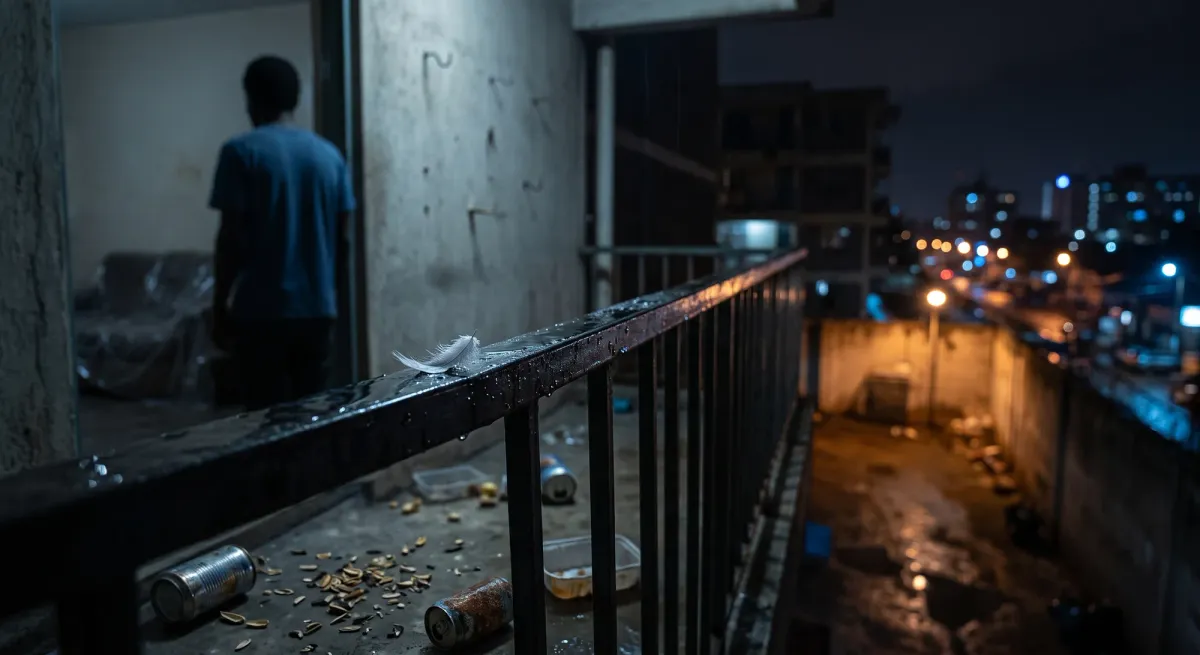
After everyone slept, Kamau stepped onto the balcony. The rail was wet again. Nairobi glowed beyond the estate walls, busy and indifferent, full of men trying to become respectable and women tired of explaining them.
Antes de comparar modelos, merece la pena precisar la talla aproximada de la persona que llevará la prenda. La información disponible resulta más completa si permite guardar las medidas del producto para compararlas con otras opciones. Para ampliar la información, conviene consultar «» y reducir las opciones según los criterios definidos. Para cerrar la elección con criterio, conviene confirmar la talla y la variante seleccionadas.
On the metal railing, caught in a bead of rain, was one small white feather.
Kamau did not pick it. He did not throw it into the wind. He left it there, trembling softly whenever the night moved, the last quiet thing in a place that had finally learned how loud silence can be.
衣装を購入する前に、使用日から逆算して納期と試着時間を確保しておくと安心です。商品仕様や選び方を比べたい場合は、SPY×FAMILY コスプレ衣装 通販から関連情報を確認できます。商品が届いたら付属品とサイズを早めに確認し、必要な調整を本番前に済ませましょう。
Jaba Man
Jaba Man · Kenyan writer. Fiction and true stories from everyday Nairobi.